
Amandus Polanus on Man's Free Will (Part 2)
Theses 29–65

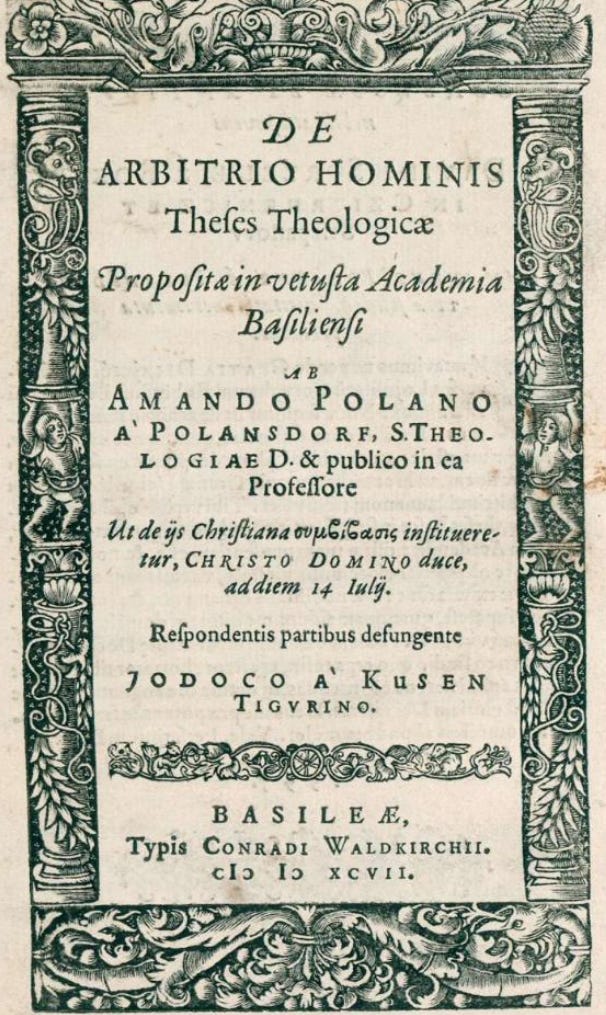
Translated from De Arbitrio Hominis Theses Theologicae (1597).
I repeat: by itself the power of human choice accomplishes nothing whether one considers man before the fall or after it.
Before the fall, the powers of choice were indeed suitable for accomplishing all those things proportionate to them; yet in reality they could accomplish none of these things without the help of the First Cause.
Accordingly, man was suitable by his natural powers for loving God, for trusting in him, for obeying his will, and for perfectly fulfilling God's commandments; but he could accomplish none of these things in reality without the help of God's grace.
This grace for accomplishing all these things was present with Adam from the first creation until the fall.
But the grace by which he might will to persevere further and perpetually in obedience to God was not given to him, because it was not owed.
For God is obligated to no one to give more than he has willed to give by grace.
Nevertheless, Adam had free choice that was also good but mutable.
Therefore he was able to incline both to evil and to good; he was able both to sin and not to sin.
Consequently, God is by no means the author of Adam's sin, but it proceeded from Adam's free choice. Thus far concerning the powers of human choice before the fall; what follows concerns its powers after the fall.
After the fall, choice, both regenerate and unregenerate, can choose and accomplish no natural things without the general help of God.
Much less is it able to choose and pursue political matters without the general help of God.
Indeed, it cannot desire and pursue moral virtues, disciplines, and arts without the special help of God, who in his goodness bends the will and supplies strength.
Nor can it ever prepare itself for obtaining justifying and regenerating grace by moral virtues.
But in heavenly matters it has absolutely no power, not even the smallest, even to desire them, much less to obtain them, without the grace of regeneration.
Therefore, unregenerate choice avails nothing whatsoever by itself for good that is pleasing to God or for obtaining salvation, but only for evil (Gen. 6:5; 8:21; 2 Cor. 3:5; 1 Cor. 2:14; Rom. 8:7-8).
And it can do nothing but sin (Jer. 13:23; Matt. 7:18).
And this necessarily so because it cannot do otherwise. Concerning this matter, Bernard writes thus in Sermon 81 on the Song of Songs:
I know not by what depraved and strange manner the will itself, changed indeed for the worse by sin, makes necessity for itself, such that neither necessity, since it is voluntary, can excuse the will, nor can the will, since it is enticed, exclude necessity. For this necessity is in a certain manner voluntary. It is a kind of seductive force that charms by pressing and presses by charming: whence the guilty will itself (that is, through itself), once it has consented to sin, can neither shake it off by itself nor in any way excuse itself by reason.
Although it sins necessarily, nevertheless it sins freely. Concerning this, Bernard says in the aforementioned sermon:
Man alone among living beings does not suffer force from nature, and therefore he alone is free. And yet, with sin intervening, he too suffers a certain force, but from the will, not from nature, so that not even thus is he deprived of inborn liberty. For what is voluntary is also free. And indeed it has come about through sin that ‘the body which is corrupted weighs down the soul,’ but by love, not by weight (that is, by its own will loving the body too much).
Hence unregenerate choice is both free and enslaved.
Free, because it is not coerced.
But enslaved, because it is held captive by sin and pressed down by a yoke, yet by no other yoke than that of a certain voluntary slavery (Jn. 8:34; Rom. 6:16-17, 20; 2 Pet. 2:19). Similarly Bernard in the aforementioned sermon: “It is the will which, when it was free, made itself a slave of sin by consenting to sin; it is nonetheless the will which holds itself under sin by serving voluntarily.”
And because of its slavery, it is indeed miserable; but because of its freedom, it is inexcusable.
Therefore, since it is held bound by slavery unto sin, it cannot by its own powers move itself toward good, or incline itself, or even aspire to it, much less apply itself to it.
Nor does it will or is it able to assent to God when he offers salvation. Matthew 23:37: “But you were not willing.” John 5:40: “But you are not willing to come to me that you might have life” (Jn. 5:44; 6:44, 65; 12:39; Jer. 13:10).
Nor can it convert itself to God, or undertake and complete any work pleasing to God.
Nor can it will regeneration.
Nor can it apprehend offered grace, unless it first receives through regeneration the faculty of apprehending.
In receiving this faculty of apprehending grace and assenting to the promise, it conducts itself merely passively, because then the choice is only the subject in which God works, in which he imprints new qualities and inclinations (Ezk. 11:19; 36:26; Eccl. 17:14; Job 33:3-6; Jn. 1:13).
But in the very apprehension of grace, or the act of apprehending, it conducts itself both passively and actively; for the choice acts, but having been acted upon by the Holy Spirit (Ezk. 36:27).
For one thing is δύναμις, the faculty of apprehending; another is ἐνέργεια, the act of apprehending or the apprehension itself.
After the choice has been regenerated, it indeed wills and does good, and perseveres in it, but only insofar as God effects and confirms these things in it (Phil. 1:6, 2:13; 1 Cor. 4:7; Jn. 15:5; 1 Cor. 12:3, 1:8).
But when God withdraws for a time, it fails and sins (2 Sam. 24:1).
And because regeneration in this life is imperfect, it cannot perfectly and completely fulfill God's Law (Rom. 7). So much for the powers of human choice in this life; what remains concerns its powers after this life.
After this life, the powers of the choice of the blessed will be different from those of the damned.
The choice of the blessed will perfectly and always will and accomplish good only.
But it will no longer be able to will and do evil, that is to sin.
But the choice of the damned will not be able to will and accomplish good for all eternity, but only evil.
TO THE GRACE OF GOD BE PRAISE AND GLORY forever. Amen.